Professional Excavators
811 Before Every Dig!
Prevent damage to underground public utilities, your crew, and your bottom line.
Single Address Request Web Ticket Entry Check Ticket ResponsePrevent damage to underground public utilities, your crew, and your bottom line.
Single Address Request Web Ticket Entry Check Ticket ResponseColorado Law requires you to request information regarding the location of underground facilities with Colorado 811 at least two (2) working / business days (not counting the day of actual notice) before any excavation or demolition starts.
Excavation means any operation in which earth is moved or removed by means of any tools, equipment, or explosives. Excavations and demolitions include, but are not limited to: Auguring, Backfilling, Boring, Boring Holes for Percolation Tests, Cable or Pipe Plowing or Driving, Demolition of Structures, Digging, Ditching, Dredging, Drilling, Driving Survey Pins, Fence Post or Pile Driving, Grading, Installing Sign Poles, Jackhammering, Milling, Moving Earth, Plowing In, Pulling In, Razing, Saw Cutting, Scraping, Setting Poles, Tree Root Removal / Stump grinding, Trenching Tunneling Wrecking, and more.
You must notify Colorado 811 regardless of where the planned excavation or demolition is located. Even if it is on private property, out in the middle of a field, or on a street that has no name. You must notify Colorado 811 even if you are only excavating a few inches. If disturbing the ground, you must notify 811 before you dig. You must notify 811 even if the property owner tells you the site has no buried facilities, or he/she knows where buried facilities are located. Make sure you have a proper location request. DO NOT rely on old marks, or another excavator’s marks or location information. Premark out the area you plan to excavate with white paint, flags, or stakes.
Before you contact 811, gather the information you need to place your locate request quickly and accurately. Information includes:
The name and telephone number of the person who is requesting the location information.
The name and telephone number of the excavator; and the specific location, starting date, and description of the intended excavation activity.
Other pertinent information regarding the dig site you would like to share or as requested by Colorado 811 to complete your locate request.
For more details review the Colorado 811 Excavation Handbook .
For “emergency excavations” or demolitions call 811 (800-922-1987) with the location of the emergency excavation or demolition as soon as possible. An emergency is any abnormal condition which presents immediate danger to life or property, including discontinuance of a vital utility service necessary for the maintenance of public health, safety and welfare. Emergency situations include ruptures and leakage of pipelines, explosions, fires, and similar instances where immediate action is necessary to prevent loss of life or significant damage to property, including, without limitation, underground facilities, and advance notice of proposed excavation is impracticable under the circumstances.
“Damage” includes the penetration or destruction of any protective coating, housing, or other protective device of an underground facility, the denting or partial or complete severance of an underground facility, or the rendering of any underground facility inaccessible.

State law requires you to contact Colorado 811 at least three business days before you dig.
Gather pertinent excavation site details and call 811 or enter a web ticket to initiate your locate request.
Allow 3 full business days for utility companies to complete the locates, not counting the day of the request.
Check for Positive Response before you start to dig.
Confirm markings are visible on site for the requested area.
If any locates are incomplete or Positive Responses are missing, submit a re-notification request.
Once a Facility Owner/Operator marks the location of existing facilities in the proposed dig site or determines that excavation or demolition is not in conflict with any of its existing underground facilities, it notifies the excavator of the status of the ticket by posting an appropriate response code through the 811 center's positive response system . In addition to positive response, additional communication may be made by any reasonable manner, including, but not limited to, face-to-face communications, phone or other electronic means.
If an excavator identifies or has knowledge of and mismarked or unmarked public underground utility, the excavator should notify Colorado 811. Better communication between the excavator and the Facility Owner/Operator is required as an area of excavation becomes more crowded with new underground facilities. The excavator reviews all positive responses and compares these to the list of all owner/operators notified on the ticket prior to beginning excavation. Upon review, the excavator notifies the 811 center of any discrepancy between the positive responses and the field conditions.
Positive Response Codes (Download) Colorado One-Call Law (Download)Stay informed and engaged with Colorado 811 through our Events Calendar. Explore upcoming trainings, Colorado 811 events, and key industry gatherings statewide—designed to help you strengthen expertise, build connections, and stay current on safety best practices.
Explore the Calendar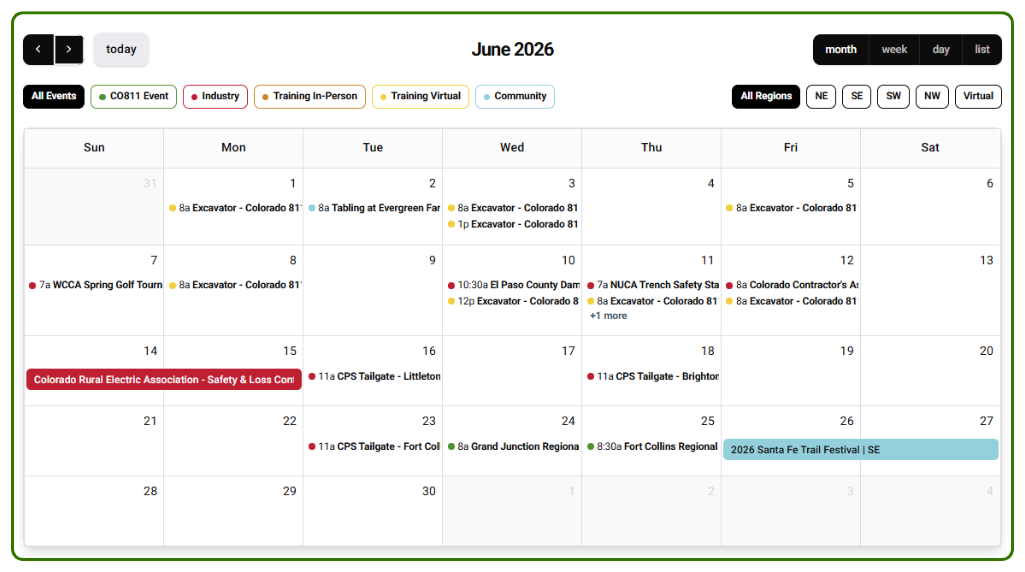
Get answers to the most common questions we hear from professional excavators.
You must notify Colorado 811 before starting any excavation. That means any operation in which earth is moved or removed using any tools, equipment, or explosives. Excavation activities include auguring, backfilling, boring, ditching, drilling, grading, plowing-in, pulling-in, ripping, scraping, trenching, hydro-excavating, post-holing, and tunneling. (C.R.S. § 9-1.5-102(3)2021). Learn more about how to dig safely.
Colorado law requires it. The law is designed to protect you and public infrastructure by helping you avoid hitting any underground utilities delivered through cables, wires or pipes. Learn more about Colorado's One Call Law.
Yes. To protect excavators and your crews and to prevent damage to underground facilities, each individual company excavating must process a ticket describing the specific location and description of their planned excavation. The only exception is when an excavator employs a secondary excavator for exposing facilities that are already marked. This rule also protects you; if any damage occurs, a ticket in your name helps show you provided proper advanced notice of excavation. See details on submitting a locate request.
Colorado 811 will collect information about your notification and map the proposed excavation area based upon the provided description and marking instructions. The information will be transmitted to the facility owner/operator members based on our mapping database. The transmission will notify registered facility owner/operator members to locate and communicate information about their facilities. See details about the utility locate process.
Yes, professional excavators can submit requests online. Click here to learn more about the Colorado 811 Exactix Ticketing System.
The public utility companies will mark the lines. Some have in-house locators, others hire a locating firm to mark their lines. Remember that there may be private utilities within your excavation area. It is your responsibility to have private utilities marked. Colorado 811 is not a locating company and does not locate utilities. Learn the difference between public and private utilities
You can start digging once you see a Positive Response status on your online ticket and have verified that all physical markings are complete. Check your status here.
If any locates are incomplete, missing markings, unfound utility, or discrepancy in Positive Responses, submit a re-notification request.
To submit a renotification the following criteria shall exist (otherwise a new request must be processed)
There was an original ticket processed
It is not more than (ten) 10 business days after the original Locate By Date
Positive Response has been verified
Utility not found in located area (It is not more than thirty (30) days after the original Locate By Date for this reason only)
Once an underground utility owner has completed your locate, they are required to post a status message—known as Positive Response—through our system so that you know your utility locate is complete and it’s OK to dig. Learn more about how to dig safely.
Utility owners and operators use American Public Works Association (APWA) standard color codes to mark the locations of their underground facilities. Learn more about Dig Safe Colors.
A facility owner/operator is an organization such as a utility company or municipality that owns and operates underground utilities. Facility owner/operators that register their underground utilities with Colorado 811 are known as members.
It depends on the location and type of utility. In addition, erosion or levelling may cause the depth of a utility to change over time. For that reason, utility owners and operators indicate depth only if it is known. Learn more about how to dig safely.
Private utilities are services that are on your job site but are not provided by public utilities. These can include water and sewer laterals, power to a detached garage, sprinkler/irrigation systems, lines connected to a propane tank or septic system, and more. These utilities are not located by contacting Colorado 811. However, you or the property owner are still responsible for having private facilities marked. Find private locating companies in your area here.
Ticket Research
Colorado 811 has a ticket research service to review past locate requests. It helps provide documentation and clarify what occurred before and during excavation.
Alternative Dispute Resolution
Colorado811 has an Alternative Dispute Resolution (ADR) program available to disputes arising from damage to underground facilities. The program is voluntary, and both parties must agree to participate and program limitations may apply.